

Rolling in their graves

There has been so much happening so quickly that I have had little time left to continue with the book project. But fear not. I’ll get the next chapter out in the not too distant future. In the meantime, I felt it was a necessary to get this off of my chest.
The Long Arc of Theocratic Ambition
People keep talking about Christian nationalism as though it is something new. It isn’t. It quite literally came over on the Mayflower.
The story most Americans carry around in their heads about the founding of this country is a charming little fable, worn smooth by generations of repetition. The Pilgrims. The Mayflower. A handful of brave souls, huddled against the Atlantic wind, seeking nothing more than the simple human dignity of worshipping as they chose. It is a story about freedom. It is a story about persecution. And like most stories that get told in elementary schools and embroidered onto decorative pillows, it is, at best, a half-truth dressed up in its Sunday best.
Let us be precise about what we mean when we say they were persecuted. Persecution implies an excess of force applied against something essentially harmless. The Quakers, for instance, were persecuted. They were quiet people with nonviolent convictions who happened to believe that God lived inside every human being rather than exclusively within the architecture of state-sanctioned churches. For that mild and rather beautiful idea, they were whipped, imprisoned, and hanged. That is persecution. What happened to the Puritans was something categorically different: they were driven out because the theology they practiced and the social order they demanded was, by the standards of the very societies they inhabited, extreme to the point of incompatibility. They did not merely want to worship differently. They wanted everyone around them to worship the same way, to live under the same punishing moral code, to submit to an interpretation of scripture so rigid and so unforgiving that even other Protestants found it excessive.
England looked at these people and essentially said: no, thank you. The Netherlands, where many of them briefly settled, said something similar, if more politely. And so they came here, to the edge of a continent where no established authority could push back, where the wilderness itself would serve as both trial and justification. They landed and they built, and what they built was not a haven of religious freedom. What they built was a theocracy. The Massachusetts Bay Colony did not tolerate dissent. It did not welcome the stranger. It expelled Roger Williams for arguing that civil government had no business enforcing religious law. It hanged Mary Dyer for being a Quaker. It pressed Giles Corey to death beneath stones. The freedom they sought was the freedom to impose, without interference, a theology that their home countries had found too severe for comfort.
This is the seed. And seeds, when planted in ground that nobody is tending, have a way of growing into whatever shape they like — even into noxious weeds.
And people brag about tracing their ancestry to the Mayflower. If only they knew.
For the better part of two centuries, this country, such as it was before it became a country, existed as a collection of European outposts with wildly divergent religious cultures. The Puritan northeast. The Anglican south. The Quaker enclaves of Pennsylvania. Catholic Maryland, at least briefly. Dutch Reformed settlements in New York. Baptists scattered like pepper across the whole landscape.
The one thing these communities shared, apart from English as a primary language and a growing resentment of being taxed without meaningful representation, was that none of them could fully agree on what God wanted. That disagreement was inconvenient for any would-be theocrat, but it was also, as it turned out, the most important structural fact in American religious history. You cannot build a Christian nation when Christians cannot agree on what Christianity requires.
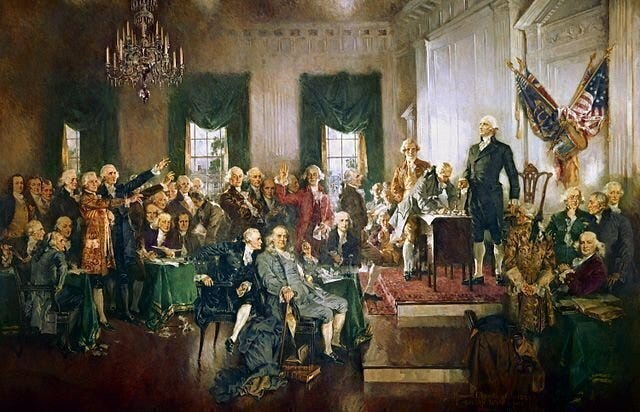
The Revolution forced the question. When the colonies decided to become something more than colonies, they had to decide what that something would look like. The men who gathered to hammer out that decision were, for the most part, not the fervently religious figures that contemporary Christian nationalists love to invoke in their faked history stories and factually handicapped tomes.
They were people like George Washington, a deist who attended church as a social obligation and a favor to his wife, Martha, but conspicuously avoided taking communion. Jefferson rewrote the Gospels with a razor blade, cutting out every miracle and every supernatural claim until what remained was a slim ethical pamphlet he found more compatible with Enlightenment reason. Franklin was a skeptic of the first order, whose relationship to organized religion was largely one of affectionate contempt. Thomas Paine, whose pamphlets had done as much as any battlefield victory to bring the Revolution into being, was so hostile to organized religion that he wrote an entire book, The Age of Reason, systematically dismantling the scriptural basis of Christianity, and was rewarded for that honesty by dying in near-total disgrace, shunned by the very country he had helped to create. Madison spent much of his political life constructing legal walls between church and state, having grown up watching Baptist preachers jailed in his home state of Virginia for the crime of preaching without a license.
These were not men trying to found a Christian nation. They were men trying to found a nation that could survive having Christians in it. They were the original American egalitarians, and their patience has cost us dearly.
Yes, the theocrats were there too, and they had names, many we recognize as some of the original revolutionaries. Patrick Henry, who had once lit a continent on fire with his rhetoric about liberty, spent his later political energy arguing that Virginia should levy taxes to support Christian churches, a proposition that Jefferson and Madison defeated by pushing through what became the Virginia Statute for Religious Freedom.
Henry was so alarmed by the secular character of the Constitution being drafted in Philadelphia that he refused to attend the Convention entirely, and then fought its ratification in Virginia with the same ferocity he had previously aimed at the British. Samuel Adams, the Boston agitator, John Hancock, and Richard Henry Lee shared Henry’s alarm. These otherwise patriotic men saw the document’s deliberate silence on God and Christ not as principled neutrality, but as deliberate insult — yet Hancock apparently got past the offense. His name became the boldest of the bold when the document was signed.
There were men who had helped build the revolution and who looked at the republic it produced and found it theologically unacceptable. The sermons poured out of pulpits across the new nation. Congregationalist and Presbyterian ministers delivered thundering condemnations of a Constitution that had failed to acknowledge the sovereignty of Jesus Christ over civil government, warning their congregations that a nation which refused to acknowledge God’s authority could not expect God’s protection. Cooler heads must have decided that they could defend themselves.
The pressure was not just rhetorical. During the ratification debates in the states, delegates repeatedly demanded amendments that would formally declare Christianity the foundation of the republic’s authority. They wanted preamble language invoking Christ. They wanted explicit acknowledgment that civil law drew its legitimacy from scripture. Even Franklin, who was nobody’s idea of a theocrat, proposed at a particularly fractious moment in the Philadelphia Convention that the delegates begin each session with prayers led by a clergyman, arguing that without divine assistance the whole enterprise would end no better than the Tower of Babel. The motion died quietly, partly because, as Hamilton noted with his customary lack of sentiment, that the Convention had no money to pay a chaplain, and partly because most delegates understood that opening that door invited more trouble than it resolved.
Mason and Madison held the line. Madison especially had thought harder than almost anyone about why establishment was the core danger. He recognized that the moment the new nation picked a faith, every other faith became a subordinate — and that would lead to trouble.
Jefferson, though absent in France during the Constitutional Convention, had already said what needed saying in the Virginia Statute for Religious Freedom, a document he was proud enough of to request it be carved on his tombstone alongside the Declaration of Independence and the founding of the University of Virginia, conspicuously leaving out his two terms as President of the United States. The man recognized priorities.
The Constitution that emerged from that long, contentious summer in Philadelphia was, by any honest reading, a secular document. God does not appear in it. Jesus does not appear in it. The only references to religion are negative in construction: Congress shall make no law respecting an establishment of religion, or prohibiting the free exercise thereof. The prohibition on religious tests for public office. The framers did not ‘forget’ to mention God. They ‘declined’ to mention God, and that was a choice made in full awareness of the theological pressures being applied and in full rejection of them.
This infuriated the theocrats who none-the-less affixed their names to the document. It has infuriated their descendants in every generation since, and ever since they have continued to try to redefine the document and force the nation into the realm of Christianity.
And so, what happened over the next two centuries was not a straight line. It was more like the tides, advancing and retreating, but if you stepped back far enough to see the whole picture, it was always moving toward the shore.
Every generation of religious nationalists convinced itself that the country had strayed from its divine mandate, that the covenant was broken, that what was needed was a restoration. A return. A revival. To hell with what a majority of the people wanted. Just like the founders of Christianity on the soil of this continent, it was Puritan Christianity that they were going to get. Over time they infiltrated every level of government, and most importantly — the schools.
Now look around and see what their single-minded assault has wrought.
That was the seed. Now we discuss the Second Great Awakening
It was a classic one-two punch.
In the early 19th century came the temperance movement and its slow march to Prohibition. We all know that part of the story well.
And then the Soviets handed these neo-Christian nationalists something they could never have conjured on their own: a genuinely godless enemy. This was the big one, and the bible-thumpers took full advantage.
Communism was, by its own proud declaration, atheist, and the nationalists spun myths and falsehood to make sure that atheism was something to be feared. The old theocratic impulse suddenly had a flag to wave and a villain to point at.
You want to know why “under God” appeared in the Pledge of Allegiance in 1954? Francis Bellamy, who wrote the Pledge, left it out on purpose. He adhered to what the founders had declared necessary. But the Communists were godless, and Americans were not Communists, and that distinction needed to be stamped into the language before somebody got confused. So here comes “under God” in the pledge and “In God We Trust” becoming the official national motto in 1956, quietly retiring the Latin phrase the founders had actually chosen. Bible-thumpers and the poorly educated everywhere rejoiced.
This was not a restoration of original intent, but insertions of what the Puritans had long ago sought — each one a small victory dressed up like a homecoming queen. It was the realization of a theocratic impulse that had been lurking just under the surface since those first ships scraped against Plymouth Rock.
The 1970s are often cited as the moment when the modern religious right was born, and there is some truth in that, but it is a partial truth that obscures the longer story. What happened in the 1970s was not a birth of something new, but an organization or coalescence of something that has been there since John Alden jumped from the Mayflower and secured that line.
Christian nationalists are nothing if not observant and prepared to take advantage of the smallest crack. They had been accumulating the raw material for decades. There was Brown v. Board of Education, which the segregationist religious establishment in the South experienced as a federal assault on their God-given social order. Engel v. Vitale in 1962 and Abington v. Schempp the following year, the school prayer decisions that were understood not as a protection of children from state-imposed religious practice but as an attack on Christianity itself. The nationalists were quick to sell it that way.
And then Roe v. Wade.
OMG, has anything rankled the nationalists so much as Roe? Women having choice over their bodies? Women having choice over anything. This was unthinkable. It became the galvanizing issue that allowed a whole new political infrastructure to be built, even though the story behind that is uglier than most people know, with the ugliest part being the number of women who fell in line behind the men.
Roe showed how quick the nationalists could be to take an advantage. Before they donned their war feathers, most evangelical leaders were largely indifferent to abortion. What actually brought them into organized politics was the IRS moving to strip tax-exempt status from segregated Christian schools, Bob Jones University being the most prominent example.
That was the original wound. But “we’re organizing to protect segregated schools” was not a banner anyone could march under publicly. Heritage Foundation founder and one of the architects of the modern religious right, Paul Weyrich, understood that. He and Jerry Falwell went looking for an issue that could do the same organizational work without the same stench, and abortion turned out to be it. Weyrich was explicit about this. The sanctity of life was not the point. The point was the machinery, and Roe handed them the fuel to run it. It’s been in perpetual motion since.
Now, Jerry Falwell and the Moral Majority did not create the Christian nationalist movement. They just gave it a mailing list and a television budget. After that, every evangelical preacher suddenly wanted to be on TV. They recognized it for what it was — a gold mine.
You see, it in this modern age it has never been about Jesus. It’s always been about power and treasure — but that’s a story for another newsletter.
What has occurred since Weyrich and Falwell is something that would have been recognizable to the founders — at least to the ones who feared it — the systematic effort to place true believers in every level of government, not because they would govern well but because they would govern righteously, according to a theology that most Americans do not share and had not chosen.
There were school boards captured by people who believe the earth is six thousand years old and that their job is not to educate children but to protect them from education that conflicts with scripture. State legislatures passed laws that encoded a singular interpretation of Christian doctrine into civil code, on abortion, on contraception, on sexuality, on the content of public school curricula.
Probably the most persistent threat over the the past 45 years is the number of federal judges appointed not for their jurisprudential rigor but for their adherence to a vision of America as a nation consecrated to a specific, narrow, Calvinist-inflected Protestant theology. Due to Weyrich and his Heritage foundation, roughly 3,500 to 4,000 federal judges fitting that description are now on the bench across all levels, district courts, circuit courts, and the Supreme Court. Heritage’s direct involvement has been concentrated in the Trump years. He has appointed roughly 230 of those judges.
The language of the nationalist has modernized. The arguments have been refined by decades of legal challenge and political calculation. But the underlying project is the same one that failed to insert itself into the Constitution in 1787, the same one that drove Roger Williams out of Massachusetts in 1636, the same one that motivated those original settlers to cross an ocean not to escape theocracy but to build one of their own in a place where nobody could stop them.
They could not have imagined that the place where nobody could stop them would eventually become a nation of 330 million people, or that the descendants of the people who had stopped them in England and the Netherlands and even in some of the other colonies would one day vastly outnumber them. But they planted something in the soil of this continent, in the architecture of its earliest institutions, in the habits of its civic functions, that did not require a majority to sustain itself. It required only persistence, and organization, and the willingness to treat democratic institutions not as ends in themselves but as tools, useful when they produce the desired outcome and to be bypassed or dismantled when they do not.
That is what we are watching now. Not a sudden eruption of something new but a very old obsession finally arriving at where it always believed it belonged. The nationalists occupying offices at every level of American government today did not come from nowhere. They came from Plymouth, and from the fever dreams of men who believed that God had promised them a continent and was merely waiting for them to take it.
The founders saw it coming. They built walls against it. Those walls have been under sustained assault for two and a half centuries, and anyone paying honest attention can see that they are crumbling. What Jefferson and Mason prevented in 1787 is being attempted again, with greater sophistication and far greater resources, by people who have learned from every previous failure and who have the institutional patience to play a very long game.
And those of us who have been watching with clear eyes since the first mushroom clouds started reorganizing the world’s priorities can only say what we have always said: we told you so. While everyone else was scanning the sky for Soviet bombers, the people who actually wanted to remake this country were filling school boards and city councils and state legislatures, one folding table and one potluck dinner at a time.
So the question is not where this came from. We know where it came from. The question is whether those of us who value the secular, pluralist republic the framers actually built, rather than the tyrannical, authoritarian theocracy their opponents always wanted, can employ the same patience, the same organization, and the same clarity of purpose that our opponents have demonstrated across hundreds of years of persistent effort. Do we have what it takes to turn the tables and take back the democracy that is being stolen from us?
Because if the answer is yes, it will cost something. It will mean accepting that your other beliefs, your faith and your religion, however passionately held, however righteous you feel it is, ride in the back seat for a while. The egalitarian society I believe we all want, the only thing at this moment worth wanting, cannot be built on a foundation that is being occupied by another version of the very thing that is trying to take it from you.
As I write this, democracy in the United States is being dismantled beneath our feet. If anyone ever doubted it, the Roberts/Alito/Thomas Supreme Court should have shaken it out of you with its decisions in Shelby County, Brnovich, Dobbs, and Callais, four cases that between them took a sledgehammer to voting rights, civil rights, and reproductive autonomy — the pillars that a genuinely egalitarian society cannot stand without. And there will be more. There always is, when the people doing the dismantling believe God told them to.
You need to become a part of the resistance, but you must secure the ground first. The framers’ republic, godless and plural and stubbornly indifferent to any one sect’s claim on power, is the only soil any of that grows in. We need to know if you’re in it for the long haul and for the good of all — religion notwithstanding.
So the real question is not whether you believe in that republic, because I know you do, but whether you believe in it enough to put everything else second until it is safe.
Can you do that?
Just remember, the story did not begin in the 1970s. It began on a shore, in a cold November, with people who were too extreme even for England. And it has never, not for a single generation, stopped.
They have the jump on us, but reversing it won’t take that long, It will, however, take time. Dress appropriately.
i knew it ran deep, but i had no idea how deep.
You and I share a common view of our history, but you have framed one of its most troubling aspects brilliantly here. Theocratic government isn't something that most Americans want - but we're getting it anyway. Perhaps it's time for secular democracy to enter its own "Great Awakening." Sharing...