

Taking a Break, Written for the Peace Page
Originally published to the Jon S Randal Peace Page

Lady Day arrived at the Lincoln Hotel through the kitchen. They made her use the service entrance. For no reason other than the color of her skin.
Good evening, Peace Page folks. Doc here with another story.
I’ve got to admit, finding new people to write about gets harder every year. Jon has covered hundreds over the time this page has been alive, which doesn’t leave a whole lot of untouched lives waiting for their turn in the spotlight. But just because Jon has written about someone before doesn’t mean I can’t take a crack at it too.
See, Jon is a storyteller. A troubadour with a keyboard instead of a lute. He spins words into pictures. Me? I’m a historian. It’s taken me years of studying how Jon writes just to get within shouting distance of his talent. What I can do is give you the facts — and this story is one of those times.
Jon wrote about her years ago in a piece that was both compelling and heartbreaking. I’ve leaned on some of the same sources he used while digging into my own version. I just hope I’ve done her, and Jon, justice.
It was 1938, and the Lincoln Hotel was one of New York City’s premier addresses, a place where Artie Shaw’s orchestra was broadcasting live on the RCA radio network to listeners across the country. Shaw’s band was the hottest dance band in America that year, and its new vocalist was the reason many people tuned in. She was twenty-two years old, already a recording artist with more than thirty singles to her name, and the finest jazz singer alive by the judgment of nearly everyone who had heard her.
She entered through the service entrance, rode the freight elevator to the stage, sang for the crowd, and then rode the freight elevator back down. She was not permitted to use the lobby bar. She was not permitted to use the dining room. She was not permitted, in a hotel she where was employed to perform in, to walk through the front door or even speak with any of the guests.
Her name was Eleanora Fagan, born in Philadelphia on April 7, 1915, the daughter of two teenagers who never married. Her mother, Sadie, was nineteen. Her father, Clarence Holiday, was seventeen. He left. Sadie worked long-distance railroad jobs that kept her away from Baltimore, where the family eventually settled, and Eleanora was passed among relatives, some of whom weren’t abusive.
She was raped at age ten and sent to The House of the Good Shepherd, a Catholic reformatory for Black girls in Baltimore, as a result. Her attacker received three months and walked free with a clean name and reputation. She received years of institutionalization. She would run from it, eventually, and by the time she was fourteen she was in New York. By the time she was fifteen she was singing for tips.
The voice that emerged from that childhood was unlike anything American music had heard. She did not have great range. She did not need it. What she had was something rarer: the ability to reshape the interior of a song, to arrive at words late or early, to place herself inside the melody the way a jazz instrumentalist does, so that the song became hers and no one else’s.
Artie Shaw, who led one of the most technically polished orchestras of the era, later said that her vocal style “has been copied and imitated by so many singers of popular music that the average listener of today cannot realize how original she actually was.” Frank Sinatra, who would become the most celebrated popular vocalist of the twentieth century, said plainly: “Lady Day is unquestionably the most important influence on American popular singing in the last twenty years.”
The nickname had come from a popular tenor saxophonist, who had started calling her by the name “Lady Day” sometime in the mid-1930s, when the two of them were running together through Harlem. She called him “Prez.” They were, by all accounts, among the closest musical partnerships the jazz world had ever produced, sharing what Prez himself described as “the same mind.”
Lady Day became Billie Holiday. Prez was Lester Young. He died in March 1959. Holiday would follow him four months later.
Before any of that, there was the tour.
In 1938, when Holiday joined Artie Shaw’s band, she became one of the first Black women to tour the segregated American South with a white orchestra and bandleader. Shaw respected her talent and, by multiple accounts, defended her when he could. In her autobiography, “Lady Sings the Blues”, published in 1956, Holiday described an occasion when she was told she could not sit on the bandstand alongside the other vocalists because of racist venue rules. Shaw told the management: “I want her on the bandstand like Helen Forrest, Tony Pastor and everyone else.”
He could not always intervene. In the 2021 documentary “Billie”, directed by James Erskine and drawn from the research archive of journalist Linda Kuehl, Shaw recalled how it actually worked on the road: white band members were given hotel rooms. Holiday slept on the bus. She learned to order an extra hamburger wherever the band stopped to eat and put it in her purse, because she knew the next restaurant might not serve her at all. She was the headline act. She rode in the bus and saved her dinner in her purse.
The Lincoln Hotel incident in November 1938 appears to have been the last straw. Holiday later described it: “I was never allowed to visit the bar or the dining room as did other members of the band... and I was made to leave and enter through the kitchen.” She left Shaw’s band shortly after. She had been earning her living, for years, in places that would not let her in through the front door. She was fed up with it.
In Louisville, Kentucky, during one of her Southern dates, a white man in the audience called her a “nigger wench” from the floor and demanded she sing something different. She had to be escorted from the stage. She had been heckled before and would be again. She never stopped performing.
What she performed, after 1939, was a song she had not written but came to own entirely.
Abel Meeropol was a Jewish high school English teacher from the Bronx who wrote under the pen name Lewis Allan. In 1937, after seeing a widely circulated photograph of two young Black men, Thomas Shipp and Abner Smith, who had been lynched in Marion, Indiana, in 1930, he wrote a poem he called “Bitter Fruit.” He set it to music and eventually brought it to Barney Josephson, founder of Café Society, the Greenwich Village club that billed itself as “the wrong place for the right people” and was, as the Library of Congress has documented, New York City’s first racially integrated nightclub. Josephson arranged for Holiday to hear the song.
She was reluctant. The material was not what she had been doing. She was known for torch songs and love ballads, not protest. But the song reminded her of something. Her father, Clarence Holiday, had been a guitarist who played with Fletcher Henderson’s orchestra and the Don Redman Big Band. He died in Dallas on March 1, 1937, of a lung disorder aggravated by his exposure to mustard gas during World War I service. He was thirty-eight years old. He was refused treatment at a whites-only hospital.
Holiday herself made the connection, in her autobiography: “It reminds me of how Pop died. But I have to keep singing it, not only because people ask for it, but because twenty years after Pop died, the things that killed him are still happening in the South.”
She agreed to sing the song.
She laid down rules for how it would be performed. Bar service would stop when she began. The lights in the room would go dark, except for a single spotlight on her face. The song would be the last thing she sang each night. There would be no encore after it. As jazz critic Leonard Feather later wrote, it was “the first significant protest in words and music, the first significant cry against racism” in American popular song.
Columbia Records, her label, refused to record it. Milt Gabler of the independent Commodore Records stepped in. The recording was made on April 20, 1939. Despite receiving no radio airplay, due to its subject matter, it sold more than a million copies. “Time” magazine named it the “song of the century” in 1999.
Holiday was a drug addict. This is not in dispute and should not be softened. She said herself she had begun using hard drugs in the early 1940s. The men in her life were, with few exceptions, abusive, exploitative, or both. Her first husband, trombonist Jimmy Monroe, cheated on her. Her second, trumpeter Joe Guy, was also her drug dealer. Her third, Louis McKay, was a mob enforcer who beat her and spent her last years swindling her out of what money she had left.
What happened to her addiction was not simply a personal failure, though it was partly that too. Jazz singer Betty Carter, interviewed in John White’s 1987 biography “Billie Holiday: Her Life and Times”, put it plainly: “When Billie Holiday got busted in the forties, when she went to jail, it was headlines in the papers. You didn’t hear so much when Anita O’Day got busted, or how many times. There was no rehabilitation places for black people, only prison.”
O’Day was white, a contemporary of Holiday’s who also struggled with heroin, was arrested on drug charges, served time, and went on to work for another forty years, dying at eighty-seven. Holiday died at forty-four.
On May 16, 1947, Holiday was arrested for narcotics possession in her New York apartment. She was at the commercial peak of her career, having earned a quarter-million dollars in the preceding three years and placed second in the “Down Beat” magazine readers’ poll for 1946 and 1947. She appeared in court on May 27. Her lawyer did not show up.
“It was called ‘The United States of America versus Billie Holiday,’” she later wrote. “And that’s just the way it felt.”
She told the judge she wanted to go to a hospital and get clean. “I want the cure,” she said. The judge sent her to the Federal Reformatory for Women in Alderson, West Virginia, where she served eight months before being released early for good behavior in March 1948. She did not sing a single note during her entire time there.
When she was released, the City of New York refused to renew her Cabaret Performer’s Card, the license required to perform at any venue that served alcohol, which in practice meant every jazz club in the city. The card system, established in 1940, gave the New York Police Department the power to deny working musicians the right to work. Holiday’s card was revoked and never restored.
“How do you best act cruelly?” singer Yolande Bavan told journalist Johann Hari years later. “It’s to take something that’s the dearest thing to that person away from them... You can’t do the thing that is a passion and that you made your livelihood at, and that has brought joy to people all over the world.”
In a 1949 interview with “Ebony” magazine, Holiday spoke about what followed her release from prison: “I came out expecting to be allowed to go to work and to start with a clean slate. But the police have been particularly vindictive, hounding, heckling and harassing me beyond endurance. These people have dogged my footsteps from New York to San Francisco. They have allowed me no peace. Wherever I go, they track me down and ask me nasty questions about the company I keep and my habits.”
She was arrested again in San Francisco in January 1949, in her room at the Hotel Mark Twain, by federal narcotics agent Colonel George White. White claimed to have found opium and a heroin kit in the room. Holiday had checked herself into a clinic the same day to demonstrate she was clean. At the subsequent trial in 1949 she had legal representation and was acquitted. The first trial had already done its damage.
Harry J. Anslinger, commissioner of the Federal Bureau of Narcotics from 1930 to 1962, was by any documented measure a virulent racist. His internal memos, preserved in government archives, described jazz as music that sounded like “the jungles in the dead of night” and stated that narcotics made “black people forget their place.” He kept a file labeled “Marijuana and Musicians” tracking prominent Black artists.
His bureau pursued Holiday, Thelonious Monk, Charlie Parker, and many others. Whether his pursuit of Holiday was specifically motivated by “Strange Fruit,” as has been widely claimed in recent years, is disputed by scholars, including jazz historian Lewis Porter, who has examined the relevant government archives and found no record of an official campaign against the song itself.
What is not disputed is that Holiday was targeted, surveilled, arrested, and stripped of her ability to earn a living in the city where she had become a star, while a white contemporary with an identical addiction moved through the same system and out the other side.
She kept performing. Without her New York cabaret card, she played theaters and concert halls. She sold out Carnegie Hall on March 27, 1948, less than two weeks after her release from Alderson. She would perform at Carnegie Hall more than twenty times over the remaining decade of her life. She kept singing “Strange Fruit” at every one of them.
By 1959, her body was failing. Decades of heroin, alcohol, and the physical toll of abusive relationships had destroyed her liver. In late May 1959, friends including jazz critic Leonard Feather, her manager Joe Glaser, and photojournalist Allan Morrison finally persuaded her to go to Metropolitan Hospital in New York. She had lost twenty pounds. Her liver and heart were both in failure.
On July 15, she received last rites. Two days later, at 3:10 in the morning of July 17, 1959, Billie Holiday died of pulmonary edema and heart failure caused by cirrhosis. She was forty-four years old.
She did not die quietly. While she lay in her hospital bed, special agents of the Federal Bureau of Narcotics came to her room and placed her under arrest for narcotics possession, handcuffing her to the bed. A police guard was stationed at the door. Flowers and notes from well-wishers were removed.
As “The New York Times” writer Gilbert Millstein, who had known Holiday personally, later wrote in the liner notes to her album “The Essential Billie Holiday”: “Billie Holiday died in Metropolitan Hospital, New York, on Friday, July 17, 1959, in the bed in which she had been arrested for illegal possession of narcotics a little more than a month before, as she lay mortally ill; in the room from which a police guard had been removed, by court order, only a few hours before her death.”
By the time she died, according to “The New York Times”, she had seventy cents in her bank account, and as Jon recounts in his July 16, 2017 telling of this tale, “$750 taped to her leg (one of her last payments, from a tabloid).”
More than 3,000 people attended her funeral Mass on July 21, 1959, at the Church of St. Paul the Apostle in Manhattan. Among the mourners were Benny Goodman, Gene Krupa, and John Hammond, the producer who had first signed her. Outside, police redirected traffic as the crowd spilled into the street.
She had been buried in an unmarked grave at St. Raymond’s Cemetery in the Bronx when the city of Baltimore, where she had grown up, began talking about a monument.
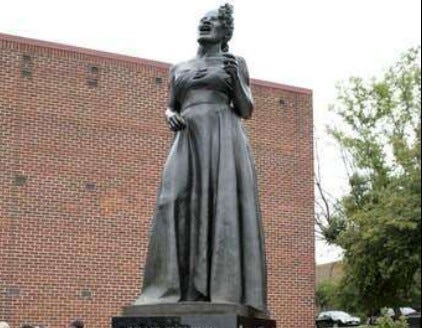
Planning started in 1971. The city commissioned sculptor James Earl Reid in 1977. Disputes over costs and creative control dragged on for years. The statue was finally unveiled in April 1985, on Pennsylvania Avenue in the Upton neighborhood, a few blocks from the Royal Theatre where Holiday had performed. It stands eight and a half feet tall in bronze: Holiday in a strapless evening gown, mouth open mid-song, a gardenia pinned in her braided hair. Reid did not attend the ceremony.
His original vision for the base had included sculptural panels depicting the imagery of “Strange Fruit” and “God Bless the Child.” City officials had found them too graphic and cut them. It took another twenty-four years. In July 2009, on the fiftieth anniversary of her death, the city rededicated the monument on a new 20,000-pound granite base. The panels that had been censored were finally added: one depicting the lynching of a Black man, the other a newborn child with its umbilical cord, the rope of “Strange Fruit” and the cord of life in the same image.
At the rededication ceremony, sculptor James Earl Reid, finally present, spoke about what the work had been trying to say all along. “She gave such a rich credibility to the experiences of black people and the black artist,” he said. “The artist must serve suffering, as well as beauty.”
On Pennsylvania Avenue in Baltimore, in bronze, in a strapless gown, with a gardenia in her hair, she is in the middle of a song. The lights are low. The waiters have stopped. Everyone is listening.
Sometimes I despair that racism will ever be overcome. It’s the playground of the idiot class, and we have an over-abundance of idiots in the world.
I saw Lady Sings the Blues when it was released in 1972. It left quite an impression on me when I was 17, and helped me to see the way racism ravages a society and demeans the very people who promote it.
Good piece, Doc. Thank you.