

Why the Farm Bill

A recent conversation with a friend brought the Farm Bill up. Maybe I misunderstood, but it sounded like she was questioning why we should be giving money to farmers. Taken at face value, her question isn’t a bad one. But it goes far deeper than that.
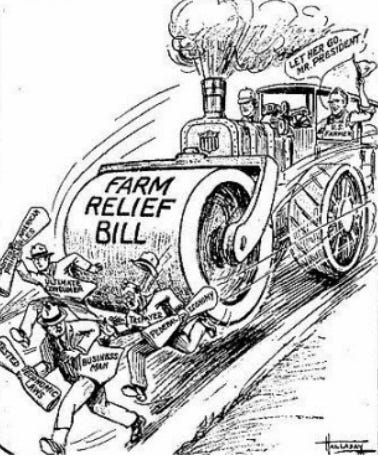
The Farm Bill is one of those pieces of legislation everyone depends on, nobody reads, and half the country thinks is just “farm money.” Like calling the internet “email.” Technically not wrong, but wildly incomplete.
So I thought I would take a few minutes, do some digging, and try to explain the whys and hows of this now-perpetual legislation.
In the beginning, the need was real and easily understood. It started in the wreckage of the Great Depression, when crop prices collapsed, farmers went broke by the millions, and hunger wasn’t a policy debate, it was a daily reality. Lines outside “sing for your supper” soup kitchens sometimes stretched for several city blocks.
In 1933, under Franklin D. Roosevelt, Congress passed the first version as part of the New Deal. The idea was simple: stabilize farm prices so farmers didn’t go bankrupt and make sure Americans could actually afford to eat. What could be more basic?
Roosevelt was blunt about why this mattered:
“Agriculture is the foundation of manufacture and commerce. If the farmer cannot produce, the wheels of industry must stop.”
Before that, agriculture ran on chaos. Farmers overproduced when prices were high, crashed the market, then underproduced when prices collapsed. The Farm Bill introduced price supports, supply management, and government purchasing to smooth those swings. It wasn’t socialism. It was economic seatbelts.
Over time, the bill evolved:
Post–World War II: Conservation Focus
• Expanded soil conservation programs
• Prevented erosion and land exhaustion like the Dust Bowl era
• Paid farmers to rotate crops, protect wetlands, and stabilize farmland
1960s–1970s: Food Assistance Becomes Central
• Federal nutrition programs folded into the Farm Bill
• Eventually developed into SNAP (food stamps)
• Linked farm production directly to hunger reduction
Mid–Late 20th Century: Research & Productivity
• Increased funding for agricultural science
• Improved crop yields and pest resistance
• Helped keep food prices lower and supply stable
Late 20th Century–Present: Rural & Environmental Investment
• Rural infrastructure (utilities, broadband, development grants)
• Conservation incentives for water protection and land management
• Environmental safeguards alongside production support
Today the Farm Bill isn’t one law so much as a massive package renewed about every five years, covering:
• crop insurance and disaster relief
• food assistance for low-income families
• conservation of land and water
• agricultural research (which quietly boosts productivity and lowers food prices)
• rural broadband, utilities, and small business support
In practice, it links farmers and consumers in one political marriage: urban lawmakers support nutrition programs, rural lawmakers support farm supports, and both sides keep the food system functioning. It’s one of the few things Congress can routinely agree on.
Which is why nearly everyone benefits:
• Farmers get stability instead of financial roulette. That keeps food production consistent.
• Consumers get lower, more predictable food prices. Without those supports, groceries would swing wildly with weather, wars, and market shocks. Think pandemic shortages, but permanent.
• The economy gets protection from agricultural collapse, which historically drags banks, transportation, food processors, and entire regions down with it.
• The environment benefits from conservation programs that pay farmers to protect wetlands, rotate crops, and prevent erosion. Those programs are the reason huge stretches of land didn’t turn into Dust Bowl 2.0.
• Rural America gets infrastructure that would otherwise never pencil out for private companies.
• And yes, hungry families get food. Which reduces crime, improves health outcomes, and saves taxpayers money long-term. Starving people are expensive.
So why is the Farm Bill constantly attacked?
Over the decades, fiscal conservatives have opposed it as “government spending,” especially the nutrition portion. During the 1980s, Ronald Reagan, our first corporate owned president since Herbert Hoover, pushed hard to cut food assistance while keeping farm subsidies politically intact, because hungry people don’t have lobbying power and agribusiness does. This was part of his “supply-side,” or “trickledown,” voodoo economics policy.
Even today there are some libertarians who oppose any market intervention at all, preferring theoretical free markets that have historically produced farm crashes, mass hunger, and government bailouts anyway. Same plot, worse ending.
Some progressives criticize how much of the subsidy money flows to large, often foreign-owned agribusiness instead of small farmers, which is a real flaw. Consolidation driven by foreclosures and structural change has tilted benefits toward massive operations growing corn, soy, wheat, cotton, and rice. Environmental groups also clash with provisions that encourage monoculture or heavy chemical use. All fair criticisms.
But here’s what critics on every side tend to miss: without the Farm Bill, the food system doesn’t become freer and better. It becomes more volatile, more expensive, and more prone to crisis. The Farm Bill is simply another thread in the social safety net.
Before it existed, farm crashes were routine. Hunger was routine. Bank failures tied to agriculture were routine. The bill didn’t create a perfect system. Given the variables, droughts, floods, harsh winters, foreign price fluctuations, a perfect system probably isn’t possible. But the Farm Bill created a survivable one.
And the whole thing is administered largely through the United States Department of Agriculture, which quietly runs one of the most effective economic stabilization systems in the country while everyone yells about culture wars.
Even the USDA itself frames the goal plainly:
“The Farm Bill provides a safety net for farmers and ranchers, protects our nation’s food supply, and supports nutrition programs that help millions of Americans put food on the table.”
Strengths
Stable food supply. Lower prices. Disaster protection. Conservation. Hunger reduction. Rural investment.
Weaknesses
Too much money to big agribusiness. Political pork. Sometimes outdated incentives. Constant hostage-taking during reauthorization fights.
But scrap it, and the people who get hurt first aren’t corporations. It’s farmers, grocery shoppers, and low-income families, followed shortly after by the broader economy.
The Farm Bill is basically society admitting that food is too important to leave entirely to market mood swings. You don’t notice it when it works. You would absolutely notice it if it vanished. It isn’t flashy. It isn’t ideological. It’s one of those boring policies that quietly keeps civilization fed.
Which is maybe why it’s always under attack.